Family Law
Marriage Registration in Rajasthan: Process, Documents and Why It Matters
By ATTPL Legal Editorial Team · · 2 min read
A practical guide to registering a marriage in Rajasthan: which law applies, who can register, documents and witnesses, the general process, and how a marriage certificate helps with passports, property, insurance and name change.
Why registration matters
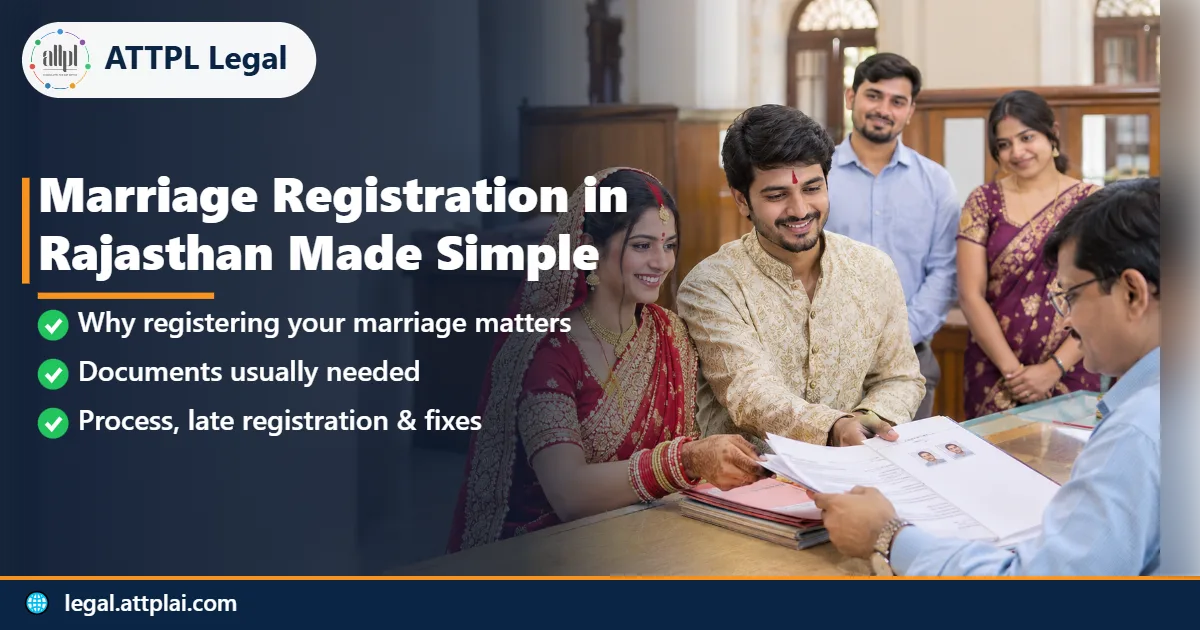
A wedding ceremony makes a marriage valid under personal law, but a marriage certificate is the official proof that the marriage took place. It is often needed for a passport or visa, a spouse's name change, joint home loans, bank and insurance nominations, claims after a spouse's death and many government schemes. In Rajasthan, the Rajasthan Compulsory Registration of Marriages Act, 2009 requires marriages solemnised in the state to be registered.
If you plan to change your surname after marriage, our guide to name change and Gazette notification explains where a marriage certificate can help.
Which law applies
- Hindu Marriage Act, 1955: for marriages between Hindus, Sikhs, Jains and Buddhists already solemnised by customary rites
- Special Marriage Act, 1954: for inter-faith couples or any couple who wish to marry or register under a civil law, with a notice period before solemnisation
- Rajasthan Compulsory Registration of Marriages Act, 2009: a state law requiring registration of marriages, including those under other personal laws
The office, forms and timelines differ under each law, so first confirm which route applies to you.
Documents usually needed
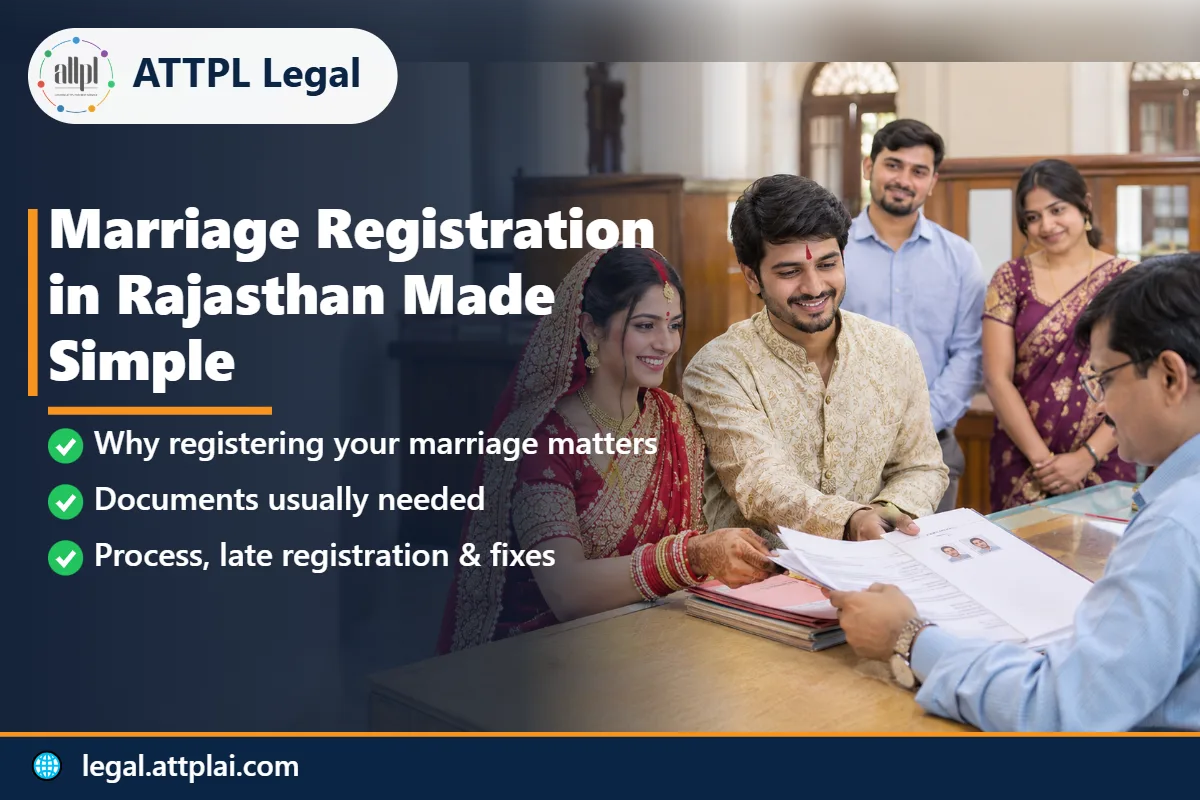
- Application form signed by both spouses
- Proof of age of both spouses, such as a birth certificate, school certificate or passport
- Proof of address, such as an Aadhaar card, voter ID or passport
- Recent passport-size photographs and a wedding photograph
- Wedding invitation card or proof of the ceremony, where available
- Identity proof of witnesses, as required by the registering office
- Affidavits or declarations about age, marital status and nationality, if asked
If either spouse was married before, keep a divorce decree or death certificate of the earlier spouse ready. The legal minimum age for marriage is 21 years for men and 18 years for women.
General process
Applications in Rajasthan can generally be started online through the state's citizen services portal or made at the office of the marriage registrar for your area. After the application and documents are submitted, the couple and witnesses are usually asked to appear for verification, and the certificate is issued once the registrar is satisfied. Under the Special Marriage Act, a notice of intended marriage is published first and objections can be raised within the notice period before the marriage is solemnised and registered.
Check the current forms, fees and appointment process with the registrar's office or the official portal before you go, because procedures are updated from time to time.
Late registration and common problems
Couples who did not register at the time of marriage can usually still apply, though the registrar may ask for extra affidavits or proof. Mismatched names or dates across documents are the most common cause of delay, so correct them first. If the registrar refuses registration, ask for the reasons in writing and consult a lawyer about an appeal or other remedy. Registration is also useful evidence in later disputes, such as those discussed in our guide to divorce by mutual consent.
ATTPL Legal
ATTPL Legal helps individuals and families in Rajasthan with documents, registrations and legal guidance. Toll-free: 1800 890 0815.
Frequently asked questions
Is a marriage invalid if it is not registered?
Generally no. A marriage valid under personal law remains valid, but registration gives official proof and is required under Rajasthan law.
Can we register years after the wedding?
Usually yes, with additional proof or affidavits. Ask the registrar's office about the current requirements.
Do inter-faith couples need a different process?
Inter-faith couples generally marry or register under the Special Marriage Act, which has a notice period and its own forms.
Sources and further reading
This article is general information, not legal advice. Procedures and requirements can change; consult a lawyer or the registering office for your situation.